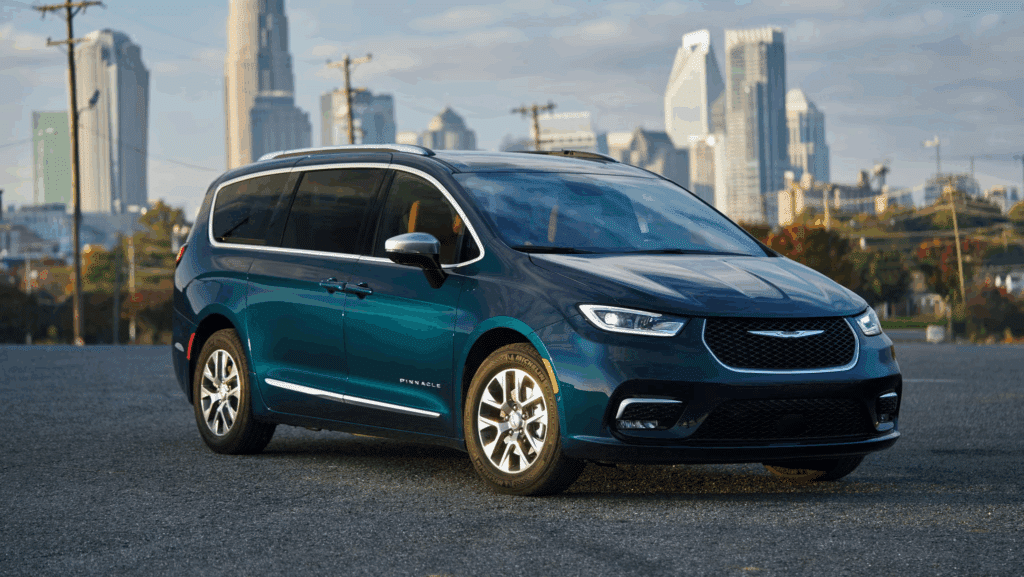
Maybe people are finally realizing the truth: a three-row SUV just doesn’t measure up to a minivan

When Dodge introduced the Caravan in 1983, families quickly fell in love with the idea of a car-like vehicle that could comfortably seat up to eight passengers. It was easy to drive, came with quirky features like wood paneling, and didn’t break the bank.
Buyers appreciated the versatility—removable seats for extra cargo room, surprisingly powerful engines, and even options with four- or all-wheel drive. Soon, nearly every major automaker jumped on the trend, from Nissan and Mazda to Ford and Chevy.
But then, seemingly overnight, the love affair ended. After decades of moving people efficiently, minivans were suddenly seen as uncool. Families shifted to three-row SUVs, drawn to their sleeker looks and the promise of more space (whether they actually offered it or not).
Minivan sales dropped so dramatically that only four true models remain: the Honda Odyssey, Kia Carnival, Toyota Sienna, and Chrysler Pacifica.
Now, in 2025, things are turning around. In fact, this might just be the Year of the Minivan. All four models are seeing a serious bump in sales—and some more than others.
Kia Carnival: The Cool Kid on the Block
Kia designed the Carnival to look like an SUV—and that clever disguise is paying off. According to Autoblog, Carnival sales are up 60% year-over-year, with an 87% surge in April alone.
For 2025, Kia gave the Carnival a facelift and added a hybrid option (borrowed from the Santa Fe Hybrid). Inside, it’s packed with family-friendly features: Passenger View, comfy seats, and a large sunroof to ease third-row motion sickness.
It’s also priced competitively. The Carnival starts at $38,283 and tops out at $52,335 for the fully loaded SX Prestige Hybrid. That’s a solid deal, especially considering the hybrid option.

Toyota Sienna: The Reliable Favorite
The Sienna has always been a strong seller, but 2025 is taking it to new heights. Toyota sold over 10,000 units in April alone—up 54% from the same time last year. Back in January, it sold just 6,400, so demand is clearly climbing.
Unlike the Carnival, the Sienna comes standard as a hybrid and offers all-wheel drive. It also throws in fun extras like a beverage cooler for second-row passengers and optional wood paneling. As expected, it’s the priciest of the four, starting at $39,185 and reaching up to $69,145 for the top-tier Platinum AWD Hybrid.
Still, it’s a Toyota—it’ll likely outlast the competition.

Honda Odyssey: Steady as Ever
While its growth isn’t as explosive, the Honda Odyssey still saw a respectable 29% bump in April, totaling 32,000 units sold.
The Odyssey doesn’t yet offer all-wheel drive or a hybrid option—something both the Carnival and Sienna have capitalized on. It remains front-wheel drive only, which may limit its appeal to buyers in colder climates.
Still, it’s a solid value. The Odyssey starts at $42,220 and maxes out at $51,180 for the Elite trim. It’s cheaper than the Carnival hybrid and a strong option for families who don’t need electrification—yet.
There’s also speculation that when the Pilot gets a hybrid engine, models like the Odyssey, Ridgeline, and Passport might follow suit.

Chrysler Pacifica: Quiet but Competitive
Chrysler only reports sales quarterly, so we don’t have fresh April data yet—but early signs are encouraging. Sales were down 2% in Q1 year-over-year, but Chrysler still moved 32,000 Pacificas during that period—matching the Odyssey’s pace.
The Pacifica is available as a hybrid with AWD and is priced competitively, starting at $44,445 and going up to $61,780 for the top hybrid trim.