
The Google-backed startup launched its first 500-kW chargers a year ago, delivering impressive results

Building EV chargers in America’s most crowded and hectic city is no small feat. Space is limited, real estate is costly, and the permitting process can stretch for months or even years. These challenges have historically restricted the availability of reliable and accessible charging networks in New York City. However, the landscape is changing, thanks to aggressive expansion efforts by the City of New York and startups like Revel and Google-backed Gravity.
Gravity, in particular, is determined to show that EV charging can be both fast and seamless. Its flagship charging station in Midtown Manhattan logged 40,000 charging sessions in its first year. While this number is modest compared to Electrify America’s 16 million sessions in 2024, Gravity prides itself on reliability. Unlike Electrify America, which struggled with reliability issues for years before improving, Gravity reported 100% uptime—ensuring its chargers were always operational.

The startup claims its Manhattan indoor charging station set speed records for several EVs, including the Tesla Cybertruck (289 kW), Cadillac Escalade IQ (369 kW), and GMC Hummer EV (374 kW). That said, Tesla’s own V4 Superchargers have been reported to peak at 325 kW for the Cybertruck.
Last year, Gravity installed 24 DC fast chargers inside a parking lot at 401 West 42nd Street, just a block from Times Square. Each charger delivers 500 kilowatts, making them the fastest claimed by any U.S.-based company so far.
“If you can make high-quality and reliable charging work in New York City, you can make it work anywhere,” Gravity CEO Moshe Cohen told InsideEVs. “We’re building for one of the most constrained areas in the world, like Manhattan.”
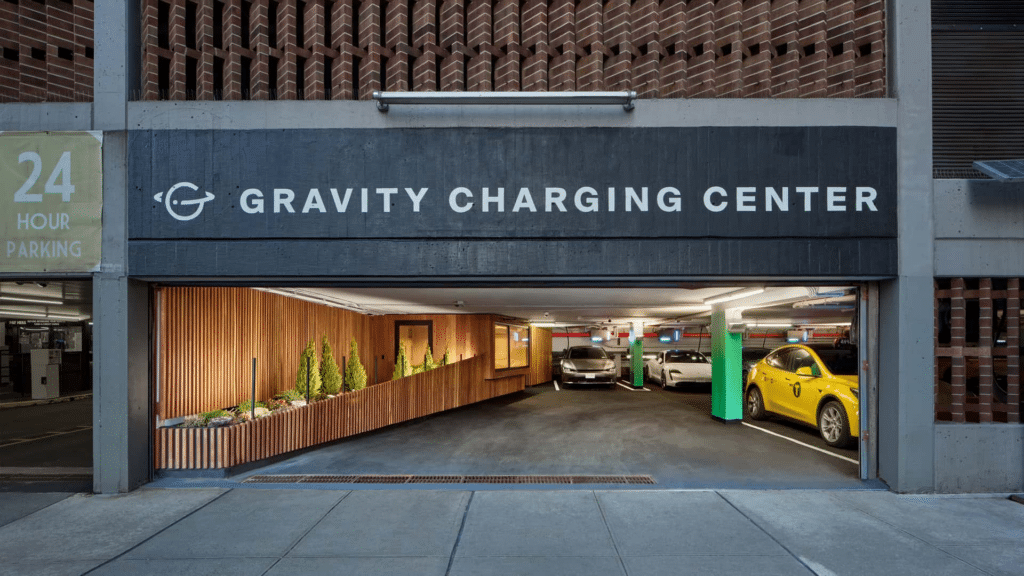
Gravity designs its own hardware and software while also operating its sites, giving it the flexibility to adapt to market demands and improve technology. The company also benefits from Google’s backing, with several former Google and Microsoft engineers contributing to its charger expansion. “We have an excellent software team with leaders that have spent many years at Google and Microsoft,” Cohen said.
Gravity claims its chargers can add 200 miles of range in just five minutes, equivalent to a rate of 2,400 miles per hour. However, actual charging speed depends on the EV’s voltage architecture. Beyond speed, a smooth charging experience requires intuitive design, accessibility, reliability, and affordability compared to gasoline refueling.
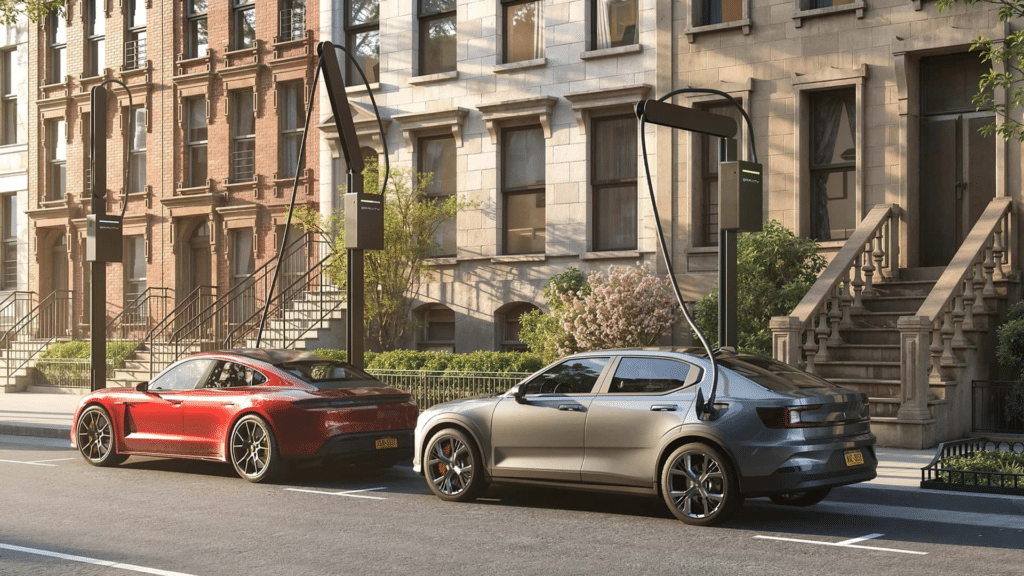
The Manhattan station operates without utility upgrades, drawing surplus electricity from the block. Chargers are mounted high on walls to keep floor space clear, and overhead cables eliminate the hassle of heavy cords.
During my visits to this station, charging was hassle-free. However, like Tesla Superchargers, Gravity’s dispensers lack screens displaying real-time charging speed and power added. Companies like the Ionna consortium are increasingly incorporating this information into user interfaces to make charging feel more like refueling at a gas station.
For now, Gravity employs on-site attendants to initiate charging, with customers paying at the end of their session, similar to a grocery store checkout. However, Cohen says a more streamlined system is in development, including an app-based interface and possibly a large on-site display.
“Many for-hire vehicle drivers want to preauthorize a specific amount of charging, like $15,” Cohen explained. “We’ve kept attendants on-site to understand different user needs and shape future plans.”
New York City has seen a surge in electric taxis due to the Green Rides Initiative, which mandates a fully electric or wheelchair-accessible rideshare fleet by 2030. Currently, 12% of the city’s for-hire vehicles—about 13,000 cars—are fully electric, and that number is expected to grow.

Initially, many of these drivers faced long waits at charging stations, cutting into their earnings. But with new fast-charging hubs from companies like Revel and Gravity, wait times are dropping, and charging access is improving.
Gravity reports at least 12% month-over-month traffic growth, with overall utilization nearing 50%. The company has big expansion plans for this year, with 20 more sites in development across New York, San Francisco, Los Angeles, Chicago, and Boston.
“What I want to see next is a shift in mindset,” Cohen said. “Buying an EV shouldn’t just be about helping the planet—it should also be the cheaper, faster, and better choice for everyday life.”