
The Cosworth-designed V-16 employs an unprecedented gear and chain drive combination, unlike anything we’ve encountered before
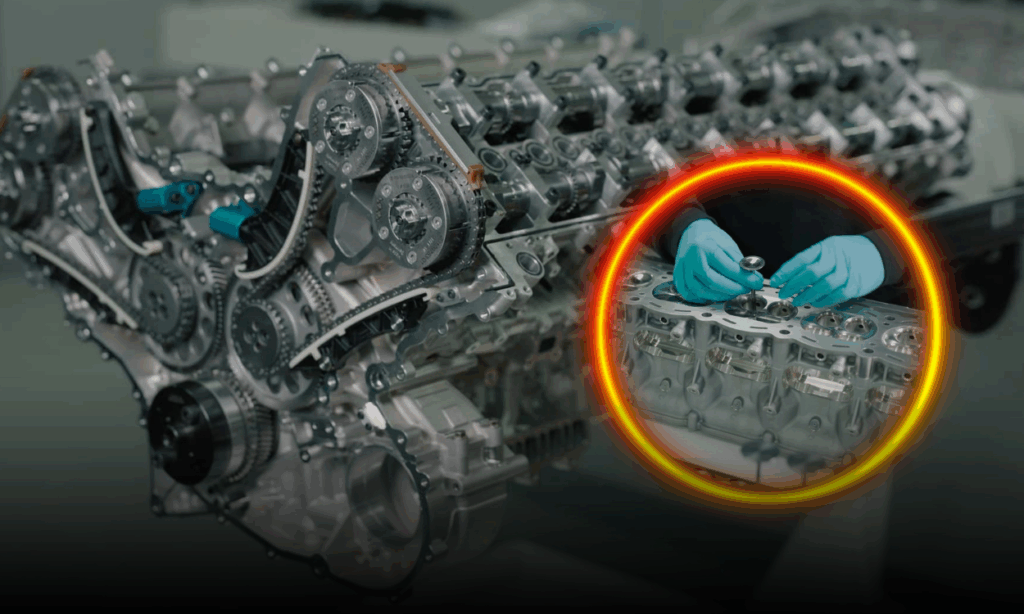
Bugatti has recently unveiled captivating visuals and details of the Tourbillon’s remarkable, naturally aspirated V-16 engine, engineered by Cosworth, prompting intense scrutiny. A standout feature is the V-16’s innovative timing system, unlike any previously observed in automotive engines.
Close examination of the engine’s front reveals a unique combination of chain and gear drive. Each cylinder bank has its own gear, intermeshing with each other and with a gear located at the crankshaft’s end. These two gears connected to the crankshaft also drive smaller gears for individual timing chains, which in turn operate the camshafts. This results in a dual timing chain setup, one for each bank of the V-16.

Both Bugatti and Cosworth have been contacted for insights into the rationale behind this unusual system, as its purpose remains speculative. One educated guess suggests that employing two chains might be a strategy to mitigate the substantial vibrations and forces inherent in a 16-cylinder engine, though this is purely conjecture. Alternatively, this configuration could offer benefits in terms of simplicity or reduced friction.
In contrast, racing engines typically utilize a fully gear-driven system for maximum reliability and high-revving capability, albeit with increased complexity and noise. Cosworth’s V-12 engines for Aston Martin and Gordon Murray Automotive are gear-driven. Perhaps Bugatti aimed to avoid the associated noise for its V-16, although the oil pump appears to be gear-driven.
Another notable detail is the prominent vibration damper, undoubtedly necessary given the crankshaft’s length exceeding three feet. The camshaft variators, responsible for adjusting valve timing, are also intriguing. They appear to be identical to those used in the Audi S4’s 3.0-liter V-6, even bearing a crossed-out VW AG marking. While the part numbers don’t match any existing components, both the Bugatti and VW/Audi variators feature “HYT DE” and “Made In Germany” embossments.
Interestingly, the two in-focus variators are both labeled “Intake RH,” suggesting a deliberate obfuscation of some engine details while providing visually appealing images. Therefore, a deep analysis of this specific labeling might be misleading.
The camshafts feature only a single profile per valve, indicating the engine likely employs variable valve timing but not variable lift. Given the Tourbillon’s hybrid system, which can deliver immediate low-end power, variable lift might be deemed an unnecessary complication, allowing the engine to be optimized for high-rpm performance with the hybrid system compensating for any torque deficits. Additionally, the valve stems appear remarkably slender.

Bugatti’s released photos also include a fascinating glimpse of a three-cylinder test mule on the Cosworth dyno. Cosworth routinely builds these three-cylinder units to validate fundamental engine aspects before constructing full-scale prototypes. Dyno shots of the V-16 showcase the stunning carbon-fiber intake plenum, equipped with four seemingly generic Bosch throttle bodies, although their part numbers are out of focus.
The accompanying video is particularly engaging, offering the auditory experience of the V-16 on the dyno as it powerfully revs to its 9,500 rpm redline, reminiscent of a NASCAR Cup car. This engine is truly unique, not solely due to its impressive cylinder count.